In this article
- Why We Score Sourdough Bread
- The Functional Purpose
- The Aesthetic Purpose
- The Blade: Choosing Your Scoring Tool
- Curved Lame (Recommended for Ear Scoring)
- Straight Lame or Razor Blade
- Kitchen Knives and Scissors
- Blade Angle: The Key to an Ear
- How Angle Creates an Ear
- How to Hold the Blade
- Cut Depth: How Deep to Score
- The Correct Depth: 6-12 mm (1/4 to 1/2 inch)
- Too Shallow (Under 5 mm)
- Too Deep (Over 15 mm)
- Depth for Decorative Patterns
- The Five Requirements for a Perfect Score
- 1. Adequate Bulk Fermentation
- 2. Strong Surface Tension from Proper Shaping
- 3. Scoring at the Correct Angle with a Sharp Blade
- 4. Cold Dough Straight from the Fridge
- 5. Steam in the First Half of Baking
- Score Patterns and Their Effects
- The Classic Ear Score (Single Off-Center Slash)
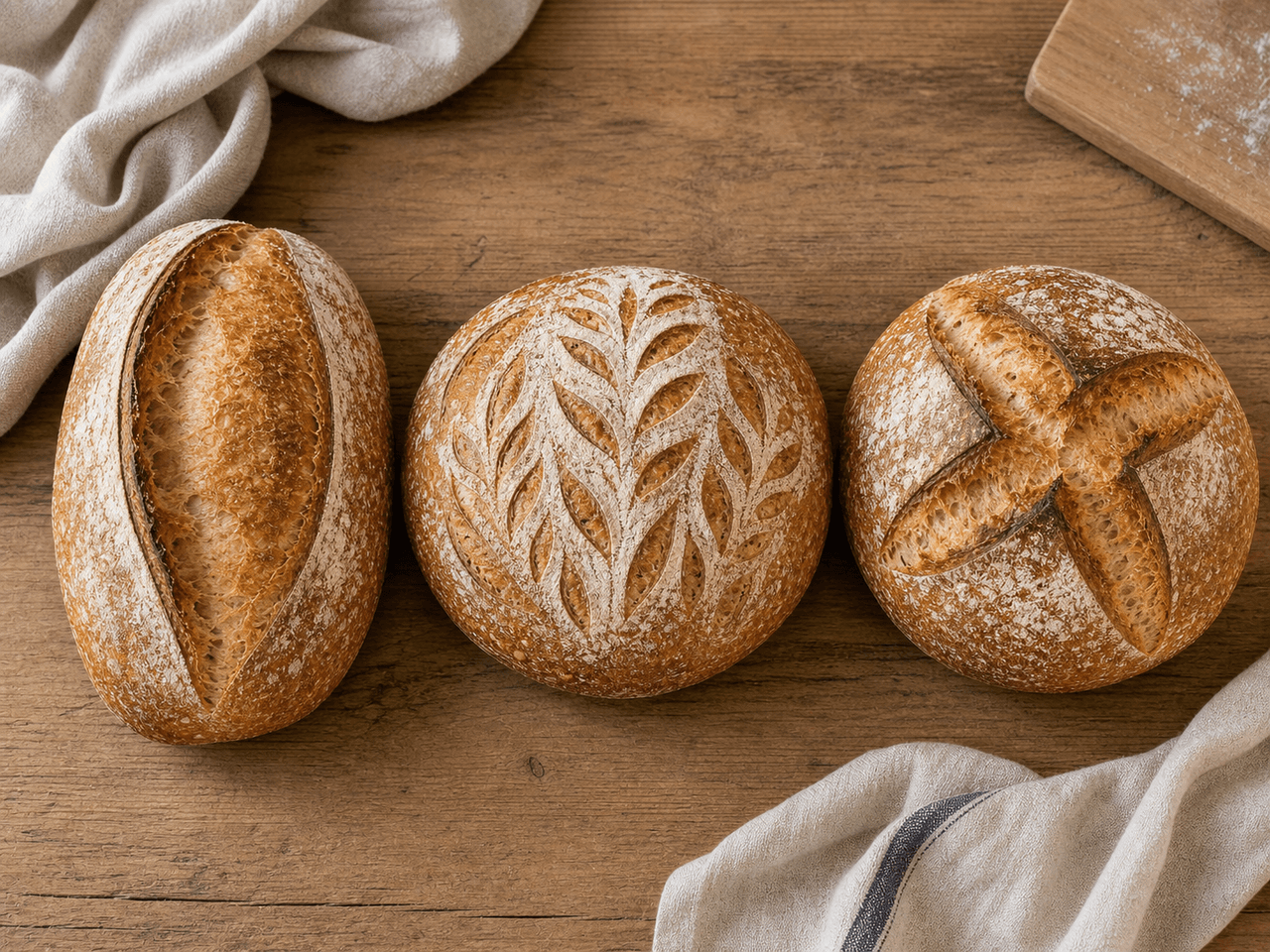
- Decorative Patterns
- Blade Maintenance
- When to Replace Your Blade
- Dull Blade vs. Sharp Blade: What You See
- Why Razor Blades Beat Kitchen Knives
- Tips for Clean Cuts
- The Shaping-Scoring Connection
- The Shaping Sequence
- Signs Your Shaping Needs Work
- Common Scoring Mistakes and Fixes
- Step-by-Step: Scoring for an Ear
- The Steam-Scoring Connection
- What Steam Does
- What Happens Without Steam
- The Dutch Oven Method
- Alternative Steam Methods
- Frequently Asked Questions
Scoring Sourdough Bread: Angle, Depth, Ear
Master sourdough scoring with blade angle, cut depth, ear formation, decorative patterns, and fixes for common scoring problems.

Scoring is the last thing you do before your bread goes into the oven, and it is one of the most misunderstood steps in all of sourdough baking. A single, confident cut can transform a pale round loaf into something with a dramatic ear, a bloom of golden crust, and a shape that looks like it came from a professional bakery. A hesitant, shallow, or poorly angled cut produces a loaf that tears unpredictably, spreads sideways, or opens flat instead of lifting.
The difference between a stunning score and a disappointing one comes down to five things — and none of them require years of practice. They require understanding. Once you know what makes a score open properly, you can achieve it on your very next bake.
This guide covers everything: why we score, the blade angle and depth that produce an ear, the five requirements that must all be met for a perfect score, decorative patterns, blade maintenance, and a complete troubleshooting section for when things go wrong.
Why We Score Sourdough Bread
Scoring — slashing the surface of shaped dough with a sharp blade just before baking — serves two purposes, one functional and one aesthetic.
The Functional Purpose
During the first 10-15 minutes of baking, the intense oven heat causes rapid gas expansion inside the dough. This is oven spring — the final dramatic rise that gives artisan bread its height and open crumb. The dough's surface needs somewhere to expand. If you provide a deliberate weak point by scoring, the dough expands there in a controlled way.
Without scoring, the dough will still expand — but it will find its own weak points. These are usually along the bottom where the dough meets the parchment, along seams from shaping, or at random stress points on the surface. The result is unpredictable tearing: sideways blowouts, bottom splits, or ragged cracks that look accidental because they are.
Scoring gives you control over where the dough opens. You decide the direction and extent of the expansion. This is not optional for freestanding loaves (boules and batards) — unscored bread almost always tears somewhere unintended.
The Aesthetic Purpose
Beyond controlling expansion, scoring is an opportunity for expression. The way a loaf opens at the score — the curl of an ear, the contrast between the scored ridge and the surrounding crust, the geometry of a decorative pattern — is what gives artisan bread its visual identity.
A well-scored loaf is immediately recognizable. The ear catches the light. The bloom has depth. The pattern tells a story of intention and control. This is why scoring photographs so well and why bakers obsess over it: it is the single most visible indicator of skill in the finished loaf.
The Blade: Choosing Your Scoring Tool
Before discussing technique, you need the right tool. The blade matters more than most beginners expect.
Curved Lame (Recommended for Ear Scoring)
A bread lame (pronounced "lahm") is a thin handle that holds a razor blade. The curved lame — where the handle has an arc that bows the blade — is the standard tool for producing ears on boules and batards. The curve naturally angles the blade against the dough surface, making it easier to achieve the 30-45 degree cut that an ear requires.
Most lames use double-edged razor blades, which are inexpensive and replaceable. The blade should be sharp enough to cut through the dough's surface with almost no pressure — if you are pressing hard, the blade is dull.
Straight Lame or Razor Blade
A straight lame holds the blade flat. This is better for decorative scoring — leaf patterns, wheat stalks, geometric designs — where you want precise, shallow cuts rather than deep, angled slashes. Some bakers use a bare razor blade held between thumb and forefinger for maximum control during decorative work.
Kitchen Knives and Scissors
Kitchen knives are not ideal for scoring. Even a sharp chef's knife has a thicker edge than a razor blade and tends to drag through the dough rather than slicing cleanly. The exception is a serrated knife for very simple cross-hatch patterns, where drag is less of an issue.
Kitchen scissors (or lame scissors, sold specifically for bread) work well for snipping patterns into rolls and baguettes — small, quick cuts that create pointed ears or wheat-stalk effects.
Blade Angle: The Key to an Ear
The ear — that thin, crispy flap of crust that curls back from the score line — is formed by blade angle. This is the single most important technical detail in scoring.
How Angle Creates an Ear
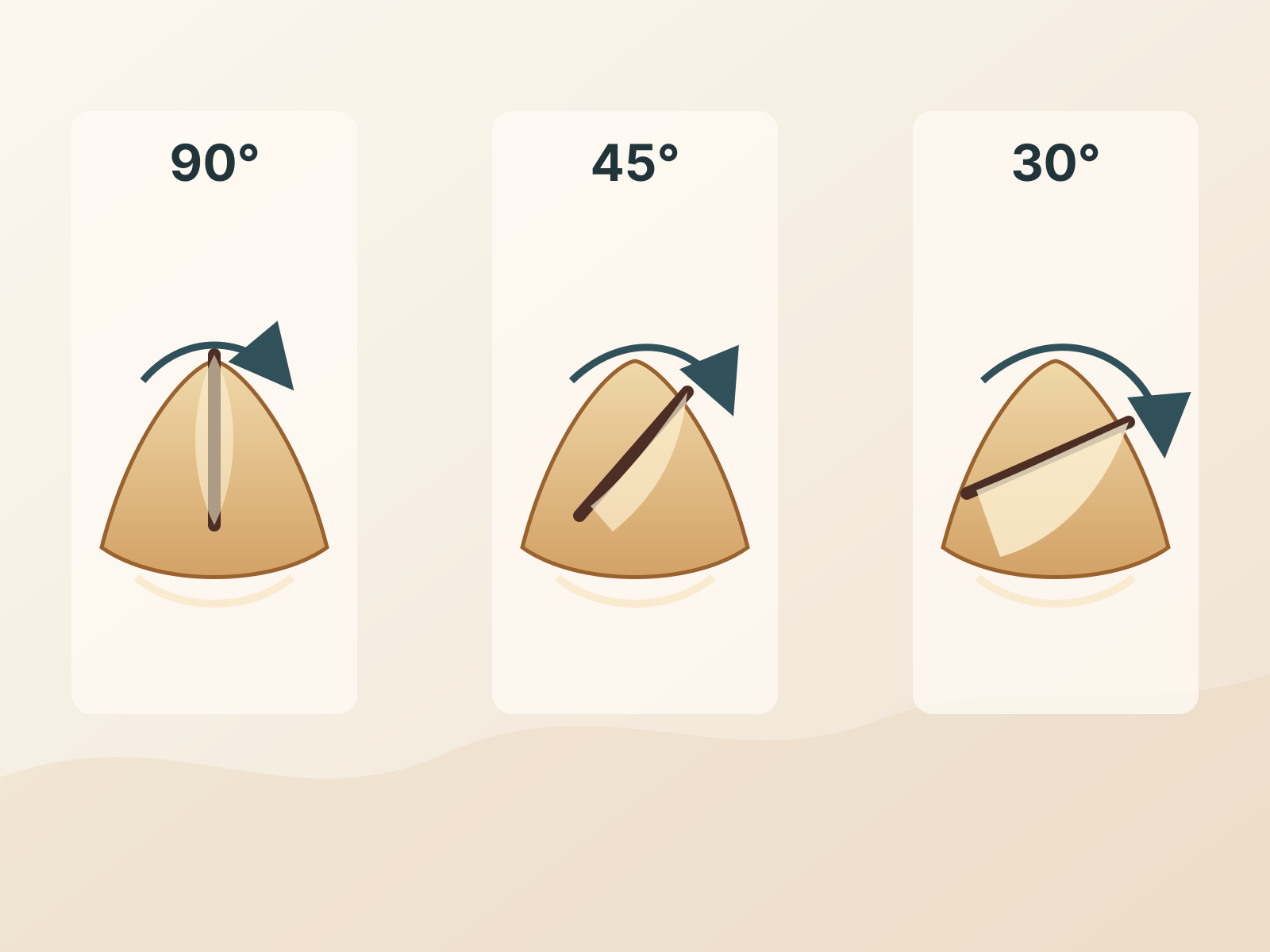
When you hold the blade perpendicular to the dough surface (90 degrees) and cut straight down, the score opens symmetrically. Both sides of the cut pull apart equally during oven spring, creating a wide, flat opening with no flap. This is fine for decorative patterns, but it does not produce an ear.
When you hold the blade at 30-45 degrees to the dough surface — almost parallel, like you are trying to shave the top layer rather than cut into the dough — the cut creates an asymmetry. One side of the cut is a thin flap (the future ear), and the other side is a deeper exposure of the dough's interior. During oven spring, the expanding dough pushes upward beneath the thin flap, curling it back. The Maillard reaction browns and hardens this flap into the crispy, caramelized ear.
The shallower the angle, the more pronounced the ear. At 30 degrees, you are essentially peeling a thin layer of dough surface, creating a wide flap that curls dramatically. At 45 degrees, the flap is smaller and the ear is subtler. Beyond 50 degrees, you lose the ear entirely and get a symmetric opening.
How to Hold the Blade
For a curved lame:
- Hold the handle like a pen, with the curved side facing down (the blade bows away from you)
- The curve naturally positions the blade at roughly the correct angle
- Your wrist should be relaxed, not stiff — let the curve do the angling work
For a straight blade:
- Tilt your hand so the blade leans at 30-45 degrees relative to the dough surface
- The blade edge closest to the dough should be the leading edge as you draw the cut
Cut Depth: How Deep to Score
Depth determines how dramatically the score opens during baking. There is a sweet spot, and the consequences of being too shallow or too deep are very different.
The Correct Depth: 6-12 mm (1/4 to 1/2 inch)
For a standard ear-producing slash on a boule or batard, cut 6-12 mm deep (roughly 1/4 to 1/2 inch). This means the blade penetrates through the dough's outer skin and into the body of the dough, but not so deep that it compromises the structural integrity of the loaf.
At this depth, the cut creates enough of an opening for oven spring to push through powerfully, lifting the ear and exposing the interior to direct heat (which creates the contrasting color between the ear and the inner bloom).
Too Shallow (Under 5 mm)
A cut that barely breaks the surface does not give oven spring a meaningful path to follow. The dough may not open at the score at all, instead tearing elsewhere. Very shallow cuts are useful for decorative patterns where you want visual lines without deep openings — but they are not functional scores.
Too Deep (Over 15 mm)
Cutting too deep can deflate the dough. You are puncturing through the gas structure that fermentation built up, and the loaf may spread sideways rather than spring upward. Over-deep scoring is uncommon — most beginners err on the side of too shallow — but it happens when bakers try to compensate for a dull blade by pressing harder.
Depth for Decorative Patterns
Decorative scores (leaves, wheat stalks, spirals) should be 3-5 mm deep — just enough to create visible lines that open slightly during baking. These shallow cuts relieve surface tension evenly across the loaf, allowing controlled expansion without a single dramatic opening point.
The Five Requirements for a Perfect Score
An ear does not come from blade technique alone. It requires five conditions to be met simultaneously. If any one is missing, the score will not open properly — no matter how skilled your blade work is.
1. Adequate Bulk Fermentation
The dough must be properly fermented — roughly doubled in volume from the start of bulk. Under-fermented dough lacks the gas pressure needed for oven spring. Without oven spring, there is nothing to push the score open. The score just sits there, a line on the surface that never blooms.
How to verify: Use an aliquot jar during bulk fermentation. When it shows 75-100% rise, the dough is ready to shape. The dough itself should be domed, puffy, jiggly when you move the container, and full of visible bubbles along the sides and bottom.
2. Strong Surface Tension from Proper Shaping
Surface tension is what gives the score something to work against. When the dough's surface is taut — like a balloon stretched tight — a score creates a controlled weak point. The tension in the surrounding skin pulls the score open as oven spring pushes from within.
Without surface tension, the dough is slack. A score in slack dough just spreads flat. It does not open upward. It does not curl into an ear. It simply becomes a wider, flatter area on an already spreading loaf.
How to verify: After shaping, the dough should hold its form on the counter without spreading. When you poke it gently, it should spring back slowly. The surface should feel taut, not sticky or saggy. If your shaped dough spreads into a pancake within minutes, the shaping was not tight enough.
3. Scoring at the Correct Angle with a Sharp Blade
This is the technique component: a blade held at 30-45 degrees, cutting 6-12 mm deep, in a single swift motion. The blade must be razor-sharp — genuinely sharp enough that it parts the dough with almost no resistance. A dull blade drags, tears, and creates ragged edges that do not lift into clean ears.
The motion: One confident stroke, about 15-20 cm (6-8 inches) long for a batard, slightly shorter and curved for a boule. Do not saw back and forth. Do not pause mid-cut. Enter the dough at one end, draw the blade through in one movement, and exit at the other end.
4. Cold Dough Straight from the Fridge
Cold dough — direct from an overnight cold retard at 3-4 °C (38-40 °F) — is dramatically easier to score than room-temperature dough. The cold firms up the fats and stiffens the gluten, creating a surface that the blade can slice cleanly rather than stick to and drag through.
Warm dough is sticky. The blade catches, the surface tears rather than cuts, and the resulting ragged score does not open cleanly. If you struggle with scoring, switching to baking from cold will improve your results more than any change in blade technique.
The workflow: Shape your dough, place it in a banneton, cover it, and refrigerate for 12-24 hours. When ready to bake, preheat your oven, turn the cold dough out onto parchment, and score immediately — before it warms up.
5. Steam in the First Half of Baking
Steam is what allows the score to open after you cut it. During the first 15-20 minutes of baking, steam keeps the dough's surface pliable and stretchable. The oven spring pushes from within, and the moist, flexible crust yields at the score line, allowing the ear to lift and the bloom to expand.
Without steam, the crust sets hard within the first few minutes. Oven spring is still happening inside, but the rigid crust cannot stretch to accommodate it. The result: the score barely opens, the ear does not lift, and the loaf may tear at the bottom or sides instead.
For home bakers, the Dutch oven is the most reliable steam method. Bake the scored loaf covered in a preheated Dutch oven (or combo cooker) at 245-250 °C (475-480 °F) for 20 minutes. The moisture from the dough itself creates the steam, trapped inside the lid. Then remove the lid and continue baking at 230 °C (450 °F) for another 20-25 minutes to set the crust and deepen the color.
Score Patterns and Their Effects
Different scoring patterns produce different results. The pattern you choose is not purely aesthetic — it determines how the dough expands, whether an ear forms, and the overall silhouette of the finished loaf.
| Pattern | Description | Ear? | Expansion behavior | Best for |
|---|---|---|---|---|
| Single off-center slash | One long cut along the length, offset from center | Yes — classic ear | Directional bloom to one side | Batards, classic artisan look |
| Single centered slash | One long cut down the center | No | Even expansion, symmetric opening | Batards, simple and reliable |
| Cross / X pattern | Two intersecting cuts across the top | No | Even expansion in all directions | Boules |
| Square or diamond | Four cuts forming a box on top | No | Four-directional expansion, even dome | Boules |
| Leaf / wheat stalk | Many shallow cuts arranged in a botanical pattern | No | Gentle, even expansion across surface | Boules, decorative presentation |
| Spiral | Curved cut from center outward | Partial | Rotational bloom | Boules, dramatic visual effect |
| Hashtag / grid | Multiple parallel cuts in two directions | No | Very even expansion | Pan loaves, focaccia |
The Classic Ear Score (Single Off-Center Slash)
This is the signature scoring pattern of artisan sourdough. A single slash runs the length of the loaf, positioned off-center — typically covering about two-thirds of the dough's width. The blade is held at 30-45 degrees and cuts 8-12 mm deep.
During baking, the oven spring pushes the dough upward on the deep side of the cut. The thin flap on the shallow side curls back, browns, and becomes the ear. The asymmetric opening creates the distinctive lopsided bloom that is the hallmark of professional sourdough.
Positioning: On a batard, the slash runs from roughly one end to the other, slightly curved, about 2-3 cm from one edge. On a boule, the slash is a gentle arc across the top, again offset from center.
Decorative Patterns
For decorative scoring, the approach changes fundamentally:
- Switch to a straight blade (or hold a razor blade flat between your fingers)
- Cut 3-5 mm deep — just enough to mark the surface
- Cut at 90 degrees (perpendicular to the surface), not angled
- Use many cuts rather than few — this distributes the expansion pressure evenly
- The many shallow cuts relieve surface tension across the entire top, so the dough expands gently everywhere rather than aggressively at one point
Decorative scoring is best done on cold, floured dough. Dust the top with rice flour before scoring — this creates contrast between the white flour and the dark, baked interior that reveals at each cut line.
Blade Maintenance
A dull blade is the most common and most easily fixed cause of scoring problems. Blade sharpness degrades faster than most bakers realize.
When to Replace Your Blade
Replace your lame blade every 3-5 bakes. Double-edged razor blades are inexpensive — a pack of 10-20 costs only a few euros — and the difference between a fresh blade and a used one is immediately apparent.
A fresh blade glides through cold dough with almost no resistance. You feel the surface parting cleanly. A blade that has been used for 5+ bakes starts to drag. You feel increased resistance, the surface tears rather than cuts, and the edges of the score become ragged instead of clean.
Dull Blade vs. Sharp Blade: What You See
| Sharp blade | Dull blade | |
|---|---|---|
| Resistance | Almost none — blade parts dough effortlessly | Noticeable drag — you press harder |
| Cut edges | Clean, smooth, defined | Ragged, torn, rough |
| Ear formation | Clean flap that curls uniformly | Uneven flap with torn edges, poor curl |
| Score opening | Opens cleanly during baking | Opens unevenly or sticks together |
| Dough sticking | Minimal | Dough catches on blade, tears |
Why Razor Blades Beat Kitchen Knives
A razor blade is ground to a much thinner edge angle than any kitchen knife — typically 15-20 degrees versus 30-40 degrees for a chef's knife. This thinner edge parts the dough surface with less deformation, producing cleaner cuts. Even a freshly sharpened chef's knife cannot match the cutting precision of a new razor blade on soft dough.
Tips for Clean Cuts
- Oil or wet the blade before scoring: some bakers dip the blade in water or lightly oil it. This reduces friction and prevents sticking, particularly on high-hydration doughs that tend to grab the blade
- Score quickly after removing dough from the fridge — the colder the surface, the cleaner the cut. As the dough warms, it becomes stickier
- Keep multiple blades on hand so you are never tempted to push a dull blade one more bake
The Shaping-Scoring Connection
Here is a truth that experienced bakers understand but that is rarely explained clearly in recipes: no amount of scoring skill can compensate for weak shaping.
Scoring is the final step in a chain. It works because the previous steps — particularly shaping — have created the conditions for it to work. If the dough lacks surface tension from shaping, the score has nothing to work against. The blade cuts through slack dough, and instead of a controlled opening that curls into an ear, you get a wound that spreads flat.
The Shaping Sequence
- Pre-shape: After bulk fermentation, gently form the dough into a rough round (for boules) or rectangle (for batards). Handle it gently to preserve the gas structure.
- Bench rest: Let the pre-shaped dough rest on the counter for 15-20 minutes. The gluten relaxes, making final shaping easier. If the dough spreads flat during bench rest, your bulk fermentation may have gone too far.
- Final shape: Tighten the dough into its final form. For a batard, fold, roll, and seal. For a boule, pull and tuck underneath to create surface tension. The surface should be visibly taut and smooth.
- Cold retard: Place the shaped dough seam-side up in a banneton, cover, and refrigerate 12-24 hours. The cold firms the dough and allows flavors to develop.
- Score from the fridge: Turn the cold dough out onto parchment (seam-side down), score immediately, and bake.
Signs Your Shaping Needs Work
If your scores consistently spread flat rather than opening into ears, and you are confident the blade angle and depth are correct, the issue is almost certainly insufficient surface tension from shaping. Common signs:
- Dough spreads sideways in the banneton during cold retard
- When turned out, the dough does not hold a domed shape
- The score line opens wide but flat — no upward lift
- The ear, if it forms at all, is thick and floppy rather than thin and crispy
The fix is not to change your scoring technique. It is to tighten your shaping. Practice creating more surface tension during the final shape, and the scores will begin to open properly.
Common Scoring Mistakes and Fixes
Even when you understand the principles, specific mistakes can undermine your scores. Here is a complete troubleshooting guide.
| Problem | Cause | Fix |
|---|---|---|
| Score does not open at all | Too shallow (under 5 mm) | Cut deeper — 6-12 mm. You should see the blade clearly penetrate the surface. |
| Score opens flat, no ear | Blade angle too steep (near 90°) | Lower the angle to 30-45°. The blade should nearly skim the surface. |
| Ear is thick and floppy | Angle slightly too steep, or cut slightly too deep | Reduce angle to closer to 30°. Cut shallower — aim for 6-8 mm. |
| Dough tears at score line | Dull blade or cutting too slowly | Replace the blade. Score in one swift, continuous motion. |
| Dough sticks to blade | Dough too warm, or blade is dull | Score colder dough (straight from fridge). Replace blade. Dip blade in water. |
| Score spreads flat instead of lifting | Weak surface tension from shaping | Focus on tighter shaping. The score itself is not the problem. |
| Loaf tears at bottom/sides instead of at score | Score too shallow, or dough over-proofed | Cut deeper. Check fermentation — if the dough is over-proofed, oven spring is weak and the score cannot relieve enough pressure. |
| Multiple scores merge into one opening | Cuts too close together | Space cuts at least 3-4 cm (1.5 inches) apart. |
| Decorative pattern disappears during baking | Cuts too shallow, or too much steam | Cut 3-5 mm deep for decorative patterns. Ensure cuts are distinct and defined. |
| Score line is ragged and uneven | Sawing motion, dull blade, or warm dough | One swift stroke. Fresh blade. Cold dough. All three matter. |
Step-by-Step: Scoring for an Ear
Here is the complete process, from fridge to oven, for producing a classic ear on a batard.
Step 1: Prepare your workspace. Place parchment paper on a peel or the back of a sheet pan. Have your lame within reach, blade fresh.
Step 2: Turn out the dough. Remove the banneton from the fridge. In one confident motion, invert the banneton onto the parchment. The dough should release cleanly (if you floured the banneton well with rice flour). The seam side is now on the bottom.
Step 3: Assess the dough. It should hold its shape — domed, firm, not spreading. If it immediately pancakes, shaping was insufficient and the score will not produce an ear regardless of your technique. Bake it anyway, but note the issue for next time.
Step 4: Position the blade. Hold the curved lame like a pen. Position the blade at one end of the batard, about 2-3 cm from the long edge (off-center). The blade should be at 30-45 degrees to the dough surface — nearly flat.
Step 5: Score. In one swift, confident motion, draw the blade along the length of the batard. The cut should be 6-10 mm deep and run about two-thirds of the loaf's length. Do not pause. Do not go back over the cut. One stroke.
Step 6: Transfer to the oven. Immediately slide the parchment (with the scored dough) into the preheated Dutch oven. Cover with the lid.
Step 7: Bake with steam. Bake covered at 245-250 °C (475-480 °F) for 20 minutes. The trapped steam keeps the crust pliable while oven spring pushes the score open and curls the ear.
Step 8: Finish without steam. Remove the lid. Reduce temperature to 230 °C (450 °F). Bake for another 20-25 minutes until the crust is deep golden brown and the ear is caramelized.
The Steam-Scoring Connection
Steam and scoring are deeply connected. Understanding this relationship explains why some bakers get perfect ears while others — with identical blade technique — get flat scores.
What Steam Does
Steam in the oven during the first phase of baking serves one critical function for scoring: it keeps the crust flexible. As long as the dough's surface remains moist, it can stretch. The oven spring pushes from within, the moist crust stretches at the score line, the thin flap lifts upward, and the ear forms.
What Happens Without Steam
Without steam, the dough's surface dries out within the first 3-5 minutes of baking. The crust sets rigid. Oven spring is still happening inside the loaf — the gas is still expanding — but the rigid crust cannot accommodate the expansion at the score line. Instead, the pressure finds other weak points (usually the bottom of the loaf or the seams from shaping) and tears there.
The result: the score barely opens, there is no ear, and the loaf has ugly tears at the bottom.
The Dutch Oven Method
For home bakers, a preheated Dutch oven (or cast-iron combo cooker) is the most reliable way to generate steam. Here is why it works:
- The dough itself contains 65-80% water (by flour weight). As it heats, moisture evaporates from the surface.
- Inside the sealed Dutch oven, this moisture has nowhere to go. It saturates the enclosed air.
- The dough surface stays moist and flexible for the full 20 minutes of covered baking.
- When you remove the lid, the moisture escapes, the surface dries rapidly, and the Maillard reaction browns and hardens the crust — including the ear.
The sequence: 20 minutes covered (steam phase) + 20-25 minutes uncovered (browning phase). This two-phase approach is the standard for home sourdough baking and reliably produces open scores and defined ears.
Alternative Steam Methods
If you do not have a Dutch oven:
- Lava rocks in a pan: Place a cast-iron pan filled with lava rocks on the lowest oven rack. Pour boiling water over the rocks when you load the bread. Creates aggressive steam for 10-15 minutes.
- Towel and boiling water: Same principle — a rolled towel in a pan, doused with boiling water at loading time.
- Ice cubes: Toss a handful of ice cubes onto the oven floor or a preheated tray. Creates a burst of steam but dissipates quickly.
None of these methods match the consistency of a Dutch oven, but they are workable alternatives.
Use recipe management directly in the proofit app — baking made simple.
See the sourdough app →Frequently Asked Questions
What angle should I hold my lame to get an ear on sourdough? Hold the blade at 30-45 degrees to the dough surface — nearly parallel rather than perpendicular. This shallow angle creates a thin flap of dough that curls back during oven spring to form the ear. The shallower the angle (closer to 30 degrees), the more dramatic the ear. A curved lame naturally positions the blade at approximately the correct angle, making it easier than a straight blade for ear scoring.
How deep should I score sourdough bread? For a standard ear-producing slash, cut 6-12 mm deep (1/4 to 1/2 inch). This depth penetrates through the dough's surface tension and into the body, giving oven spring a clear path to push through. Cuts shallower than 5 mm often fail to open. Cuts deeper than 15 mm risk deflating the dough. For decorative patterns (leaves, wheat stalks), cut 3-5 mm deep.
Why does my sourdough score not open? The most common reasons are: the cut was too shallow (under 5 mm), the blade was dull and dragged rather than cut, the dough lacked surface tension from insufficient shaping, the dough was over-proofed and had no oven spring, or there was not enough steam in the oven during the first phase of baking. All five of these conditions must be met for a score to open properly.
Why does my sourdough have no ear? An ear requires a specific blade angle (30-45 degrees), adequate oven spring from proper fermentation, strong surface tension from shaping, cold dough from the fridge, and steam during the first 20 minutes of baking. If any one of these five elements is missing, the ear will not form. The most common culprits are blade angle too steep (closer to 90 degrees) or weak surface tension from shaping.
Should I score sourdough cold or at room temperature? Always score cold — straight from the fridge. Cold dough (3-4 °C / 38-40 °F) is firmer and less sticky, allowing the blade to cut cleanly and precisely. Room-temperature dough is soft and sticky, causing the blade to drag and tear rather than slice. Scoring cold dough is easier, produces cleaner lines, and results in better ears.
How often should I replace my lame blade? Replace the blade every 3-5 bakes. Double-edged razor blades are inexpensive, and sharpness degrades noticeably with use. A fresh blade glides through cold dough with almost no resistance. A blade used 5+ times drags, tears the surface, and produces ragged score lines that do not open cleanly. Keep a supply of replacement blades on hand.
Can I score sourdough with a kitchen knife? You can, but the results will not match a razor blade. Kitchen knives have a thicker edge angle (30-40 degrees) compared to razor blades (15-20 degrees), which causes more drag and tearing through soft dough. For simple cross-hatch patterns a serrated knife works, but for ear scoring, a razor blade in a lame is strongly recommended.
What is the best scoring pattern for beginners? A single off-center slash along the length of a batard is the best pattern to start with. It is simple (one cut), forgiving (small angle variations still produce results), and produces the most dramatic visual result — a classic ear. Once you are comfortable with this, try a cross pattern on a boule (two intersecting cuts) or a square pattern (four cuts forming a box).
Why does the dough stick to my blade when scoring? Three common causes: the blade is dull (friction increases sticking), the dough is too warm (sticky surface), or the dough is very high hydration (above 78%). The fixes: use a fresh blade, score directly from the fridge before the dough warms, and dip the blade in water or lightly oil it before cutting. Work quickly — the faster the stroke, the less time the blade is in contact with the dough.
How does shaping affect scoring results? Shaping creates the surface tension that scoring relies on. Without taut surface tension, a score has nothing to work against — it simply spreads flat instead of opening upward into an ear. If your scores consistently open wide but flat, with no upward lift, the problem is almost certainly in your shaping, not your scoring technique. Focus on creating a tighter, more taut surface during final shaping.
What is the difference between a curved lame and a straight lame? A curved lame bows the blade, naturally angling it against the dough surface. This makes it easier to achieve the 30-45 degree cut needed for ear formation. A straight lame holds the blade flat, which is better for decorative scoring (perpendicular cuts at 90 degrees). Most bakers own both: a curved lame for functional ear scores and a straight lame or bare blade for decorative patterns.
Why did my decorative scoring pattern disappear after baking? Decorative cuts were likely too shallow. At under 2 mm, the expansion of the dough during baking can close the cuts entirely. Cut 3-5 mm deep for decorative patterns. Also ensure the cuts are distinct and well-spaced. If the dough's surface is very wet, dust with rice flour before scoring — this helps preserve the visual definition of the pattern through baking.
Does the number of scores affect how the loaf bakes? Yes. Fewer, deeper cuts concentrate the oven spring at those points, producing dramatic openings (and ears, if angled correctly). Many shallow cuts distribute the expansion pressure more evenly across the surface, resulting in a gentle, uniform rise without dramatic openings. A single deep slash produces the most pronounced ear. A leaf pattern with 20+ shallow cuts produces even expansion with decorative detail.
How do I score a boule versus a batard? For a batard: one long, off-center slash along the length, at 30-45 degrees, 6-10 mm deep. For a boule: a curved arc across the top (also off-center for an ear), or a cross/square/decorative pattern for even expansion. The key difference is that a batard's elongated shape lends itself to a single directional slash, while a boule's round shape works well with both single arcs and multi-directional patterns.
Can I practice scoring before baking day? Yes. Cold, shaped dough is the best practice surface, but you can also practice on a ball of cold, firm dough kept in the fridge specifically for practice. Some bakers practice on the smooth side of a partially inflated balloon to develop muscle memory for the swift, confident motion. The most important thing to practice is committing to the stroke — entering with the blade and drawing through without hesitation.